
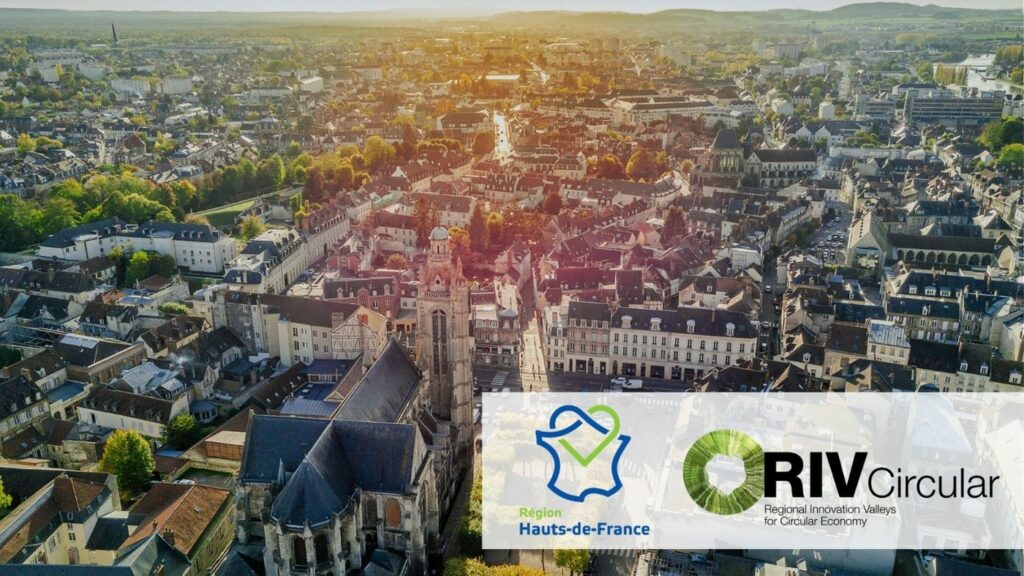
The Hauts-de-France region is undergoing a major transformation by embracing the circular economy as a driver of sustainable growth. With strong industrial roots in sectors such as automotive, textiles, agri-food and metallurgy, Hauts-de-France offers fertile ground for circular solutions.
Through its “Third Industrial Revolution” (REV3) roadmap, and “Regional strategy for the Circular Industry” (PAIC) the region is rethinking production and consumption models to address environmental challenges while maintaining economic competitiveness.
This dynamic ecosystem is supported by around 20 clusters and technology centres, including notably Team2 (circular economy), Euramaterials (materials), CD2E (sustainable construction), Polenergie (industrial symbiosis) and CITC EuraRFID (digital innovation).
Concrete projects driving change
This transition is already visible through practical initiatives. Platforms dedicated to the reuse and repair of industrial equipment are extending machinery lifespans, while in the agri-food sector, organic waste is being transformed into biogas or compost, creating local circular loops.
The textile industry, another regional pillar, is also evolving by promoting fibre recycling and eco-friendly clothing production, in response to growing consumer demand for sustainable products.
A key challenge: Electrical Vehicles’ battery circularity
Hauts-de-France aims to position itself as a leading European “Battery Valley”. Therefore, one of the region’s most strategic priorities is the circular management of electric vehicle batteries. As demand for electric mobility and energy storage rises, recycling batteries — rich in critical materials such as lithium, cobalt and nickel — has become essential to reduce environmental impact, secure supply chains and limit reliance on primary materials.
Several very large factory that produces batteries for electric vehicles (gigafactories) are being established with the support of major players such as Automotive Cells Company (ACC), Verkor and Envision-Renault.
At the same time, new reuse / recycling initiatives are emerging. Start-up Battri launched a facility in 2025 capable of processing 15,000 tonnes of end-of-life batteries annually, while Mecaware is developing capabilities to refine “black mass” materials in Béthune.
In parrallel to the installation of gigafactories and reuse / recycling initiatives, the region launched the «Regional collective for e-mobility» (COREM) that supported the development of the battery ecosystem with over 13,000 jobs expected, more than €25 million invested in workforce training, over 220 stakeholders involved and more than 20 investment or R&D projects launched.
Complementary projects such as SEPAR8, RECYBAT and SMARTBAT, funded by Hauts-de-France Region through the Just Transition Fund, focus on substituting critical raw materials, improving recycling processes and enhancing battery performance and safety, ultimately extending battery lifespan and maximising resource efficiency.
A regulatory framework favourising the Circular Economy
The development of the circular economy in Hauts-de-France is supported by a robust regulatory framework at European, national and regional levels. EU policies on waste, recycling and single-use plastics have significantly shaped the transition, while France’s Anti-Waste Law for a Circular Economy (AGEC, 2020) sets ambitious targets for waste reduction, reuse and producer responsibility.
At regional level, the “Regional strategy for the Circular Industry”, launched in 2025, further fosters the development of circular ecosystems in construction & demolition, new business models, and more. In addition, strategies such as the SRDEII (economic development plan), SRADDET (sustainable planning framework) and PRPGD (waste prevention and management plan) translate national objectives into concrete actions.
A strategic opportunity
By combining industrial strength, innovation capacity, logistics infrastructure and strong public support, Hauts-de-France is positioning itself as a European leader in the circular economy. In particular, its ambition to lead in battery circularity places the region at the forefront of a rapidly growing sector that is crucial for the energy transition.