
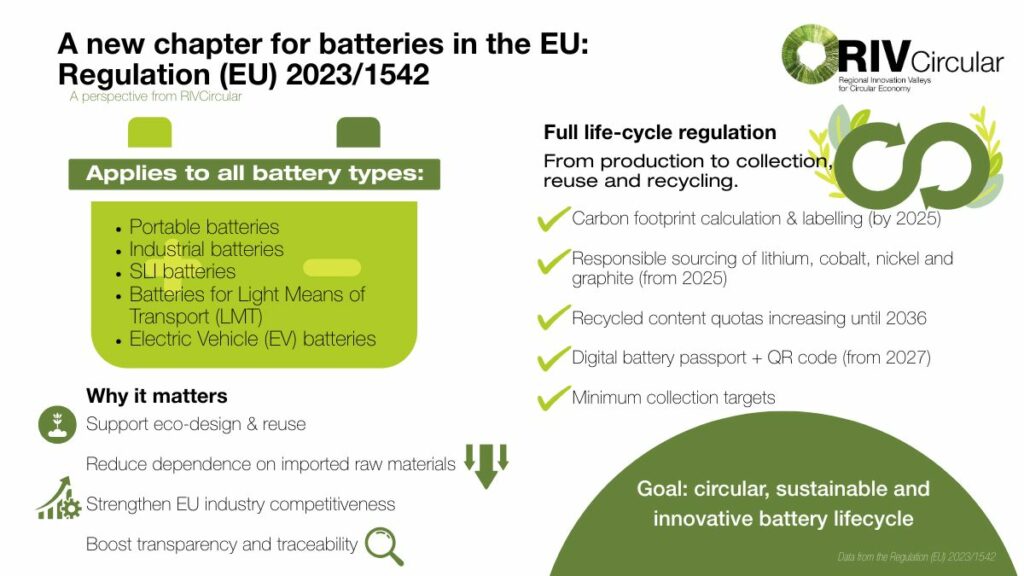
The European Union has entered a new era in its battery policy, placing sustainability, circular economy, and innovation at the heart of the energy transition. With the adoption of Regulation (EU) 2023/1542, the EU replaces the outdated Directive 2006/66/EC, updating its legal framework to align with current climate and circular economy objectives.
This regulation, which came into force in August 2023, establishes a comprehensive approach that covers the entire life cycle of batteries placed on the European market. In fact, it applies to all types of batteries:
- Portable batteries
- Industrial batteries
- SLI batteries (Starting, Lighting, and Ignition)
- Batteries for Light Means of Transport (LMT) such as e-bikes and e-scooters
- Electric Vehicle (EV) batteries
This regulation covers everything from battery manufacturing and usage to collection, reuse, and recycling.
As a key innovation, manufacturers will be required to calculate and label the carbon footprint of EV, LMT, and industrial batteries — with a phased rollout until 2026.
Another major innovation from this regulation is that, from August 2025, companies must ensure traceability and responsible sourcing of lithium, cobalt, nickel, and natural graphite, verified by independent third parties.
From the same year, batteries will also need to contain minimum levels of recycled materials, with targets that will increase progressively until 2036.
Additionally, all EV, LMT, and large industrial batteries must have a digital battery passport and a QR code label providing key product information.
Finally, manufacturers must commit to achieving minimum collection targets for used batteries:
- Portable batteries: 63% by 2027, 73% by 2030
- LMT batteries: 51% by 2028, 61% by 2031
Why These Changes Are a Game-Changer
By combining innovation, sustainability, and responsible sourcing, the new regulatory framework aims to:
- Promote eco-design and battery reuse
- Reduce dependence on imported critical raw materials
- Strengthen the competitiveness of the European battery industry
- Improve transparency and traceability across the entire value chain
Implementation Challenges
Although the Regulation sets out a clear roadmap toward a more circular and sustainable battery value chain, its effective implementation faces a number of urgent challenges.
Significant progress has been made in developing the technical standards, delegated acts, and digital tools needed to operationalize the new requirements. However, key aspects are still under development, leading to uncertainty for many stakeholders.
Additionally, some critical deadlines — such as those concerning due diligence in raw material sourcing and carbon footprint thresholds — have been postponed allowing for more coherent and effective implementation across the EU.
Another key challenge is improving recycling and recovery infrastructure across Europe. Without strong investment in local industries, it will be hard to meet the regulation’s recovery goals, and the EU could become dependent on other countries for essential materials. At the core of RIVCircular, we are committed to driving high-TRL innovative projects to help the ecosystem meet these requirements.
More information: Full regulation text on EUR-Lex