Capacity building has become a key component in driving the circular economy. This transition not only entails the adoption of new technologies, but also profound transformations in knowledge, skills, and institutional structures. By encompassing a wide range of technical disciplines and sectors, the circular economy demands a cross-sectoral approach that must be reflected in policies, programs, and funded projects aimed at accelerating its implementation.
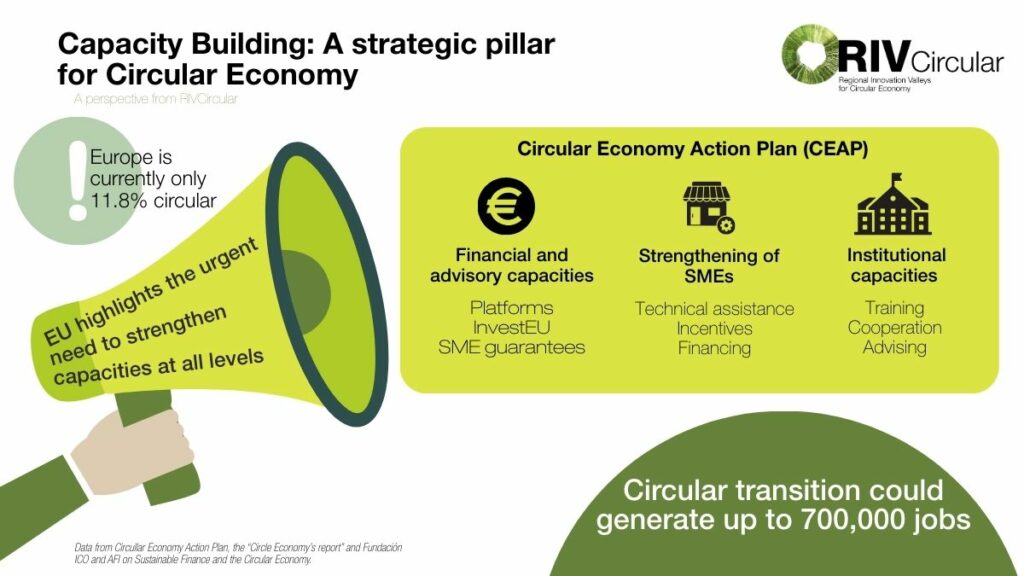
Various European Union documents highlight the urgent need to strengthen capacities at all levels: from small and medium-sized enterprises (SMEs) to public institutions. Among them, the most representative is the Circular Economy Action Plan (CEAP), which provides an ambitious roadmap to make the circular economy the new European economic standard.
One of the key areas addressed by the CEAP is the development of financial and advisory capacities. Through platforms such as the Circular Economy Finance Support Platform, the European Union provides guidance to project promoters on circular incentives, financial structuring, and risk management. It also relies on tools like InvestEU and specific guarantees for SMEs, with the goal of facilitating access to sustainable investments.
Another fundamental axis is the strengthening of SMEs, which often lack technical knowledge on circularity. The plan offers tailored support through technical assistance, incentive schemes, and adapted financing mechanisms, in order to ease their transition towards more sustainable and resilient production models.
Likewise, the CEAP places particular emphasis on building institutional capacities at the national and regional levels. To this end, programs have been designed for authorities responsible for managing European funds, including webinars, peer-learning spaces, and advisory services for designing circular project portfolios in key sectors such as water, bioeconomy, or manufacturing.
In parallel, the plan promotes knowledge sharing and the exchange of best practices. This dimension materializes through the creation of collaborative platforms, methodological guidelines, and the dissemination of success stories, aiming to support policymakers and public administrations in integrating circular criteria into their strategies and procurement processes.
In summary, the Circular Economy Action Plan fosters capacity building along three complementary lines:
- Financial support, through dedicated platforms and funds.
- SME empowerment, via technical and financial tools.
- Institutional strengthening, through training, strategic assistance, and cooperation among stakeholders.
This comprehensive approach is essential to transform the current linear economic model into a truly circular and regenerative economy.
According to Circle Economy’s report, Europe is currently only 11.8% circular, highlighting the long road ahead. In this context, training specialized personnel and raising public awareness are key factors. In fact, the study by Fundación ICO and AFI on Sustainable Finance and the Circular Economy estimates that the circular transition could generate up to 700,000 jobs, showing that capacity building is not only urgent but also represents a strategic opportunity for Europe’s economy and employment.