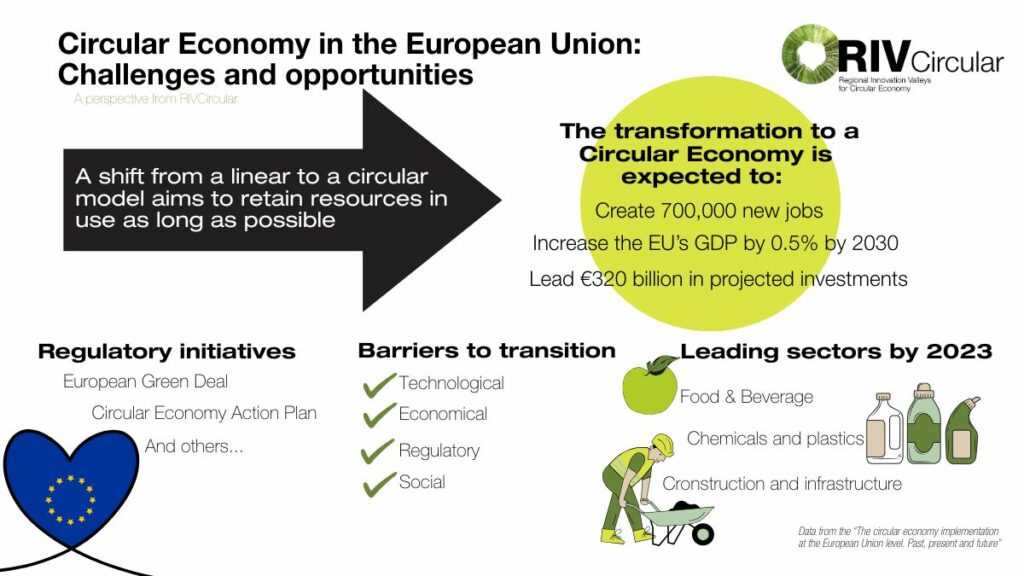
The Circular Economy (CE) is shaping the future of Europe, aiming to replace the traditional “take-make-dispose” model with sustainable, closed-loop systems. According to recent studies, recycling represents 24.2% of all circular strategies in the EU, with the Food & Beverage sector leading at 17.9%, followed by Chemicals and Plastics at 16.4%.
The European Green Deal and CE Action Plans are driving this change, with forecasts of 700,000 new jobs and a 0.5% GDP increase by 2030 if circular models are widely adopted. Key actions include waste reduction, eco-design, and the use of secondary raw materials to cut dependence on limited natural resources.
Still, there are roadblocks: high costs, low market competitiveness of recycled products, regulatory gaps across EU countries, and low consumer awareness. Technological limitations—like the lack of advanced recycling solutions—also slow progress.
By uniting businesses, policymakers, and citizens, Europe can overcome these barriers and build a resilient, resource-efficient economy worth over €320 billion in potential investments by 2025.
How is the Circular Economy progressing in the European Union? Challenges, progress, and opportunities
In recent years, the Circular Economy (CE) has emerged as a key strategy for building a more sustainable, innovative, and resilient Europe. Unlike the traditional linear model, based on producing, consuming, and discarding, the CE seeks to keep resources in use for as long as possible, reducing waste, increasing efficiency, and creating value at every stage of the production cycle.
To accelerate this transition, the European Union has developed a solid regulatory framework. Notable initiatives include the European Green Deal, the new Circular Economy Action Plan (2020), and the Farm to Fork strategy in the agri-food sector. These plans promote more sustainable value chains, waste reduction, and the design of products that are made to last, be repaired, and recycled.
Moreover, this transformation is expected to create 700,000 new jobs and increase the EU’s GDP by 0.5% by 2030, with more than €320 billion in projected investments across key sectors such as mobility, construction, and food.
Which sectors are leading the way?
According to a 2023 research paper, the sectors implementing the greatest number of circular strategies include Food and Beverage (17.9%), Chemicals and Plastics (16.3%), and Construction and Infrastructure (11%).
But what exactly are they doing? Most actions focus on material and waste recycling. However, other high-potential strategies—such as eco-design, product sharing, or digital platforms for resource exchange—remain underutilized
Barriers slowing the transition
Despite progress across various sectors, the implementation of Circular Economy principles still faces significant challenges at different levels.
Many companies, especially SMEs, lack the technical knowledge or access to technologies needed to redesign products, processes, or business models around circular principles. Additionally, recycled materials are often perceived as lower quality, which discourages both producers and consumers from using them.
Economic barriers are another key limitation. Insufficient funding, high initial implementation costs, and the low prices of virgin raw materials often make circular models less competitive than linear ones.
Regulatory inconsistencies between countries and the lack of essential infrastructure also hinder large-scale implementation of circular strategies.
Finally, many businesses are still rooted in traditional models and show resistance to change. Added to this is the lack of awareness among consumers about the benefits and availability of circular products.
Looking ahead: Innovation and projects driving change
European projects such as RIVCicular are at the forefront of this transformation.
The transition to a Circular Economy will not happen by itself. It demands proactive policymaking, cross-sector collaboration, technological innovation, and the active participation of citizens. Beyond being an environmental imperative, the Circular Economy is also a powerful driver for creating a more competitive, fair, and future-ready Europe.