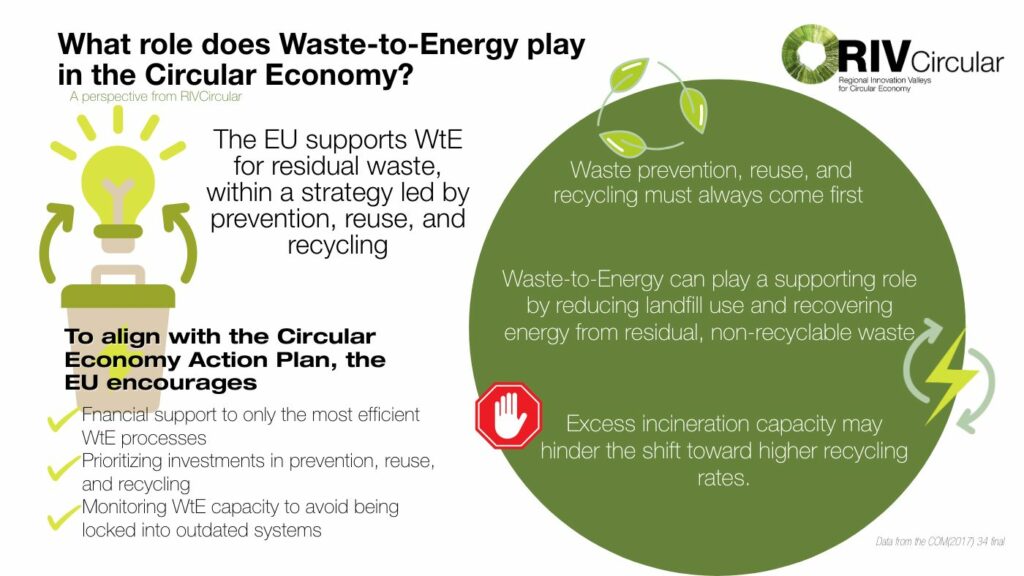
In 2017, the European Commission launched the communication “The role of waste-to-energy in the circular economy” (COM(2017) 34 final), as part of a set of key initiatives supporting Europe’s transition toward a circular economy.
The document explains that while this practice can be useful, it should not be the first option. The top priority should always be to prevent waste generation. If waste does occur, it should first be reused or recycled. Only when those options are not viable, should energy be recovered from it before final disposal. Over-reliance on incineration or similar technologies for energy production may hinder more sustainable alternatives like recycling.
Another key point highlighted in the document is that each country must carefully plan its waste treatment infrastructure to avoid becoming dependent on technologies that may become outdated or counterproductive to environmental goals.
The Commission emphasizes that advancing toward a more circular economy is not only beneficial for the environment but also creates opportunities for employment, innovation, and economic growth. Therefore, EU countries are encouraged to use European funds to invest in clean, efficient technologies aligned with the continent’s climate objectives.
Circular economy approach provides greater access to secondary raw materials, reducing dependence on extracted natural resources such as oil, minerals, or water.
It is also a key sector for job creation. Preventing, repairing, reusing, and recycling all these actions require a significant workforce. In fact, according to the document, between 2012 and 2016, the value of environmental goods and services in the EU grew by 50% in terms of GDP, resulting in more than 4 million green jobs during that period.
On a global scale, the World Bank estimates that over the next decade, up to €6 trillion will be invested in clean technologies in developing countries. Of this amount, €1.6 trillion could be accessible to European SMEs that commit to green innovation.
This means that investing in the circular economy is not only good for the planet — it also opens up new international markets.
In summary, this communication emphasizes that, when properly managed, energy recovery can play a useful role within the circular economy. However, the clear priority must always be to prevent waste generation, and to promote reuse and recycling before considering waste-to-energy solutions. Furthermore, it highlights the EU’s role as a driving force behind a more sustainable, competitive, and job-creating economic model, aligned with the global Sustainable Development Goals.